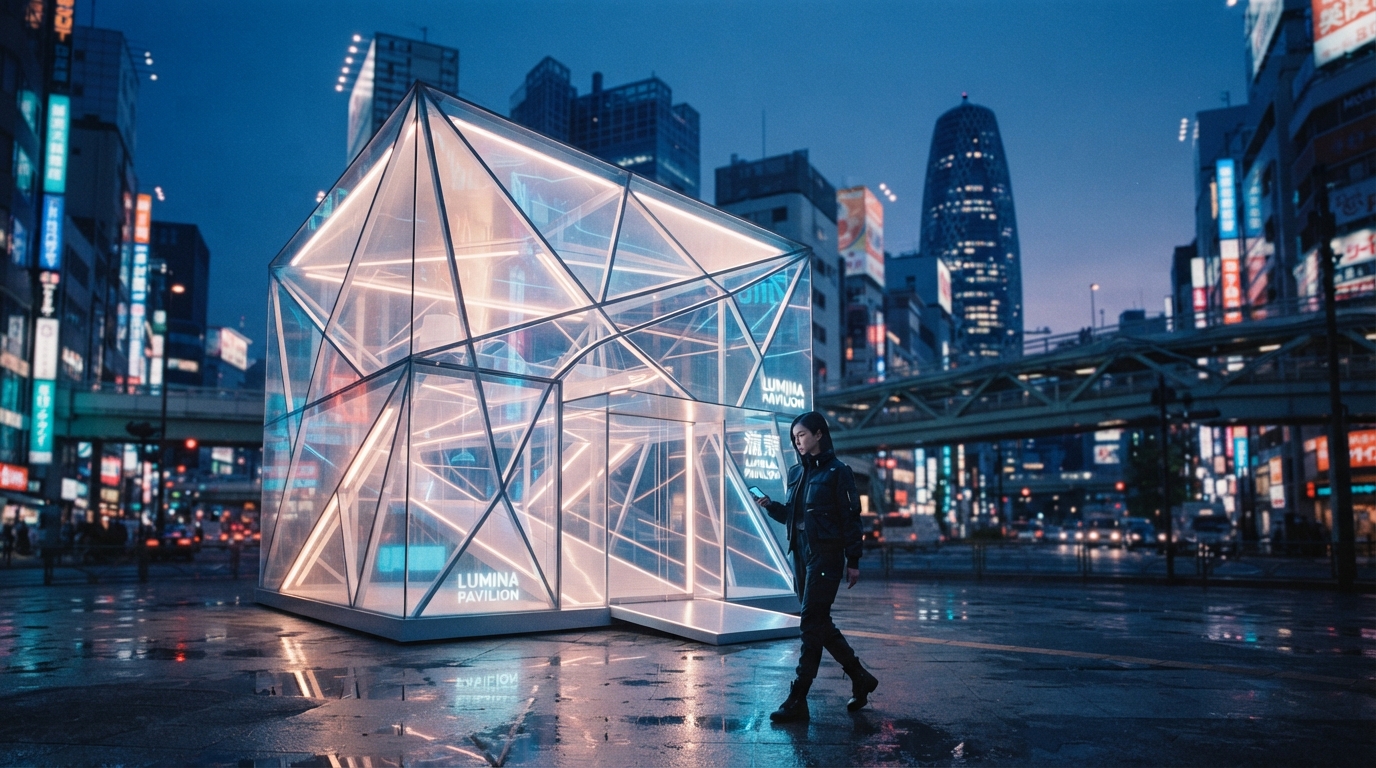
The Dissolution of Solid Envelope
To stand inside the western perimeter of Shinjuku Chuo Park at 18:00 is to witness the boundary conditions of contemporary architecture quietly dissolve. Tokyo has historically been a city of hyper-dense physical layerings—brutalist flyovers casting shadows across postwar yakitori alleys, monolithic glass towers housing financial algorithmic exchanges, and narrow residential corridors where square footage is rationed with surgical precision. Yet over the past eighteen months, an ephemeral architectural typology has taken root across thirty-two municipal pockets.
These installations, designated simply as Lumina Nodes, represent neither conventional physical architecture nor mere immersive projection mapping spectacle. Built utilizing high-tensile carbon-fiber skeletons and double-layered optical diffraction envelopes, they function as micro-sanctuaries of pure light. Within these crystalline cubes, physical mass is treated as scaffolding for sub-millisecond photonic rendering.
Light as a Load-Bearing Material
“We were exhausted by the static permanence of cement,” explains Dr. Reiko Moriyama, chief architect at Studio Metatone. “Traditional architecture commands humans to conform to inert geometries. When a wall is fabricated from steel and drywall, its relationship to the occupant is totalitarian. But when a wall is synthesized from 480 million phase-modulated light vectors per cubic meter, the room learns your breathing cadence before you have even consciously settled.”
The core breakthrough relies on edge-synchronized gallium-nitride laser arrays situated within the perimeter foundation plinth. Rather than projecting onto a two-dimensional sheet, these emitters focus focal depth fields in open air through controlled Rayleigh scattering. As visitors walk through the aperture, geometric boundaries shift in direct response to ocular convergence data captured by ambient infrared sensors.
Latency as an Aesthetic Dimension
For generations, architectural theorists treated latency solely as a network performance metric—a lag in milliseconds relegated to online multiplayer servers or automated algorithmic trading floors in Nihonbashi. In the Lumina Nodes, however, latency has been repurposed into a radical sculptural medium.
By tuning the frame delivery pipeline to intentional micro-delays—introducing what designers call “temporal breathing”—the pavilion’s walls appear to stretch and inhale as atmospheric humidity shifts. The experience does not feel like standing inside a screen; it feels like standing inside the cerebral cortex of an intelligent, benevolent entity.
The Refusal of Real Estate Scarcity
In an era where urban square meters in central Tokyo command prices surpassing ten million yen per tsubo, the philosophical implications of zero-latency holographic envelopes are revolutionary. If an empty twelve-square-meter plaza can transform on demand into a cathedral, an acoustic concert chamber, or a sun-drenched coastal clearing, the tyranny of spatial scarcity begins to crumble.
Yet questions of sovereignty remain unresolved. Who governs the optical code executed inside these municipal pavilions? When a citizen steps within, their neural telemetry and gaze habits are captured to optimize refraction fields. As the boundary between civic commons and proprietary server clusters blurs, Tokyo’s boldest architectural experiment may yet become either its greatest democratic sanctuary or its most seductive panopticon.